

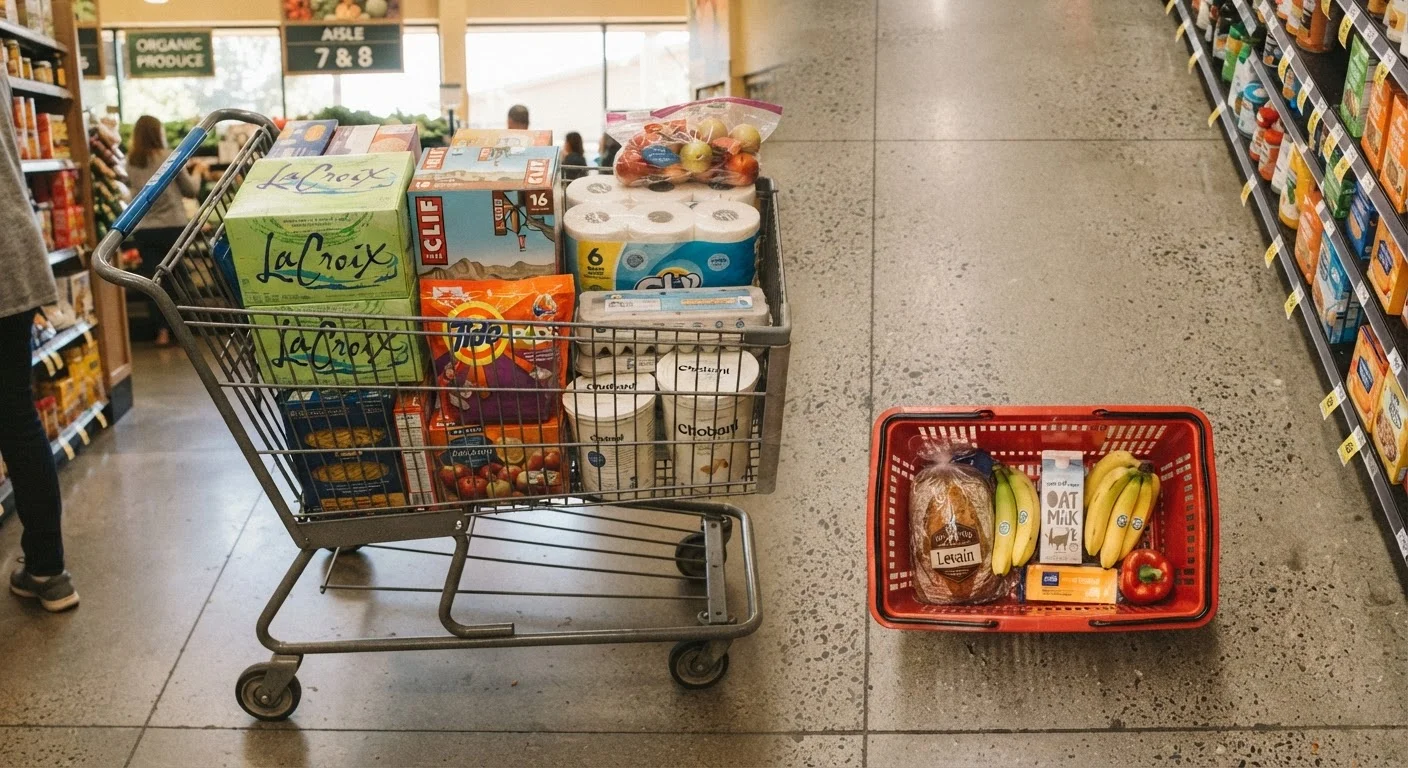
Key Takeaways
Option A
Bulk buying
The high-volume, lower-per-unit approach.
Best for: Larger households with stable storage space and predictable consumption of non-perishable goods.
Option B
Buying as needed
The flexible, pay-only-for-what-you-use method.
Best for: Smaller households, renters with limited storage, or families with irregular schedules and variable tastes.
If you have a large household consuming the same products every week
Bulk buying
Predictable consumption of staples like paper towels, canned goods, and laundry detergent means bulk quantities get used before expiration and the per-unit savings accumulate meaningfully over time.
If your household is small or your income arrives irregularly
Buying as needed
Smaller quantities protect cash flow and prevent over-purchasing items that may go unused or expire, which erases any theoretical savings.
If storage space is limited in your home
Buying as needed
Without space to store large quantities safely, bulk packages often create clutter, spoilage, or duplicate purchases that cost more in the long run.
If you track a detailed monthly household budget
Bulk buying
Families with a clear spending plan can absorb the higher upfront cost of bulk items and accurately calculate the per-unit savings against their regular retail baseline.
How bulk buying actually saves money (and when it does not)
The appeal of bulk buying rests on one straightforward math: divide the package price by the unit count and compare it to the per-unit price at a standard grocery store. For many non-perishable staples, that calculation favors the larger package. Cleaning supplies, paper products, canned goods, dried pasta, and similar items have long shelf lives and consistent household demand, so the lower per-unit cost translates into real savings over months of use.
The calculation breaks down in a few common situations. First, if the product expires or spoils before the household finishes it, the wasted portion cancels the per-unit advantage. Second, bulk purchases require upfront cash that smaller households may not have available in a given pay period. Third, some warehouse-style memberships carry annual fees; a family that buys only a handful of bulk items may not recover that fee through savings alone. Before committing to a membership, it helps to map out your monthly spending categories so you can project whether bulk savings will outpace the membership cost.
A factor families often overlook is the behavioral pull of abundance. When a large quantity of a product is visible in the pantry, consumption tends to rise. That effect can offset per-unit savings if the household ends up using more of the item than it otherwise would.
The real cost of buying as needed
Buying as needed means paying a higher per-unit price in most cases, and that premium is real. A single roll of paper towels from a convenience store costs considerably more per sheet than one roll pulled from a 12-pack. For a family running tight on cash month to month, the higher unit price on routine purchases adds up across a year.
That said, buying as needed has genuine financial advantages that per-unit math alone does not capture. Cash flow stays flexible, so money is not tied up in inventory sitting on a shelf. Waste is minimal because purchases match immediate demand. Families in smaller homes or apartments avoid the practical problem of finding places to store large packages. And when tastes change, such as a child who suddenly refuses a previously reliable product, the household is not stuck with a 48-count supply of something nobody will eat.
The as-needed model also pairs naturally with sale cycles. A family that monitors weekly store circulars and buys a modest extra quantity when a reliable staple goes on promotion can capture some of the unit-price benefit of bulk buying without committing to warehouse quantities. Core deal-finding habits can make this approach more systematic without requiring significant time investment.
| Criterion | Bulk buying | Buying as needed |
|---|---|---|
| Per-unit cost | Lower on most staples | Higher in most cases |
| Upfront cash required | Higher per trip | Lower per trip |
| Storage space needed | Significant | Minimal |
| Spoilage or waste risk | Higher for perishables | Low |
| Flexibility for changing needs | Low once purchased | High |
| Works well with sale cycles | Sometimes, with planning | Yes, on smaller quantities |
| Membership or club fee | Often required | Not required |
Which categories favor each approach
Not all product categories respond the same way to bulk or as-needed purchasing. Non-perishables with long shelf lives and stable household demand are where bulk buying performs best: laundry detergent, dish soap, canned tomatoes, dried beans, rice, and similar pantry staples. These items are also frequently the ones where combining a coupon with a bulk purchase can produce meaningful savings, though families should verify the final unit price still beats the regular per-unit retail.
Fresh produce, bread, dairy, and prepared foods almost always belong in the as-needed column. Spoilage risk is high, and household preferences for fresh items shift frequently. Buying a week's worth of produce is reasonable; buying a month's worth is not.
Clothing, back-to-school supplies, and seasonal items sit in a middle ground. Stocking ahead during off-season clearance can reduce total spending for families who know sizes and needs with confidence. Parents who plan ahead for the school year can find that approach useful, and a pre-season shopping checklist helps avoid guessing on sizes or quantities. For nutritional guidance on stretching grocery purchases further, see eating well on a tight grocery budget.