

Key Takeaways
Why so many families overspend at national parks
National parks have a reputation for being affordable family travel. That reputation is mostly earned, but families still consistently spend more than they need to. The entrance fee gets paid, and then money quietly drains into paid concession tours, gift shops, and outside activities that seemed necessary but were not.
The National Park Service runs a large portfolio of free and low-cost programming that goes largely unadvertised beyond a pamphlet at the entrance gate. Families who know what to look for can fill two or three full days at a single park without spending anything beyond that initial fee, or nothing at all on designated free-entry days.
This connects directly to how budget-conscious families approach the broader trip. See our road trip planning guide for how to cut costs before you even arrive. And if you are building a vacation from scratch, the start-to-finish budget vacation walkthrough covers how national parks fit into a full low-cost itinerary.
Junior Ranger program
Nearly every national park runs a Junior Ranger program. Kids pick up a free activity booklet at the visitor center, complete age-appropriate tasks during the visit (observing wildlife, attending a ranger talk, sketching a landmark), and then get sworn in as a Junior Ranger and receive a free badge or patch.
The program is self-paced and works across a wide age range, roughly 4 to 12, though many parks have materials for older kids and toddler-level versions as well. It gives children a structured reason to pay attention and engage with what they are seeing rather than asking when the trip is over. Parks including Grand Canyon, Yellowstone, Acadia, and Zion all run their own versions with park-specific content.
The Junior Ranger booklet alone can occupy kids for a full day at no cost.
Fee-free entry days
The National Park Service designates several days per year when entrance fees are waived at all fee-charging parks. These typically fall around Martin Luther King Jr. Day, the first day of National Park Week in April, the anniversary of the Great American Outdoors Act in August, National Public Lands Day in September, and Veterans Day in November. Specific dates shift year to year, so check the NPS website before booking travel.
For a family of four visiting a park with a $35 per-vehicle fee, a single fee-free day covers the entrance cost entirely. Scheduling a trip around one of these dates is one of the most straightforward ways to trim park spending without giving anything up.
Scheduling around a fee-free day eliminates entrance costs with no trade-offs.
Ranger-led programs
Ranger-led programs are included with park admission and cover an range of formats: guided hikes, campfire talks, tidepool walks, cave tours (at select parks), and geology or ecology presentations. Many run daily during peak season. Programs are listed on each park's official NPS page and on the free NPS app under the 'Things to Do' section.
These programs are consistently one of the highest-value free activities in the system. Rangers know the park in depth, engage kids directly, and cover content you would not find in a guidebook. A one-hour ranger-led hike often delivers more context about a park than a full self-guided day would.
A ranger-led hike covers more ground intellectually than a full self-guided day.
Every Kid Outdoors fourth-grade pass
The Every Kid Outdoors program issues a free annual pass to all U.S. fourth graders that covers entrance fees at national parks, national forests, national wildlife refuges, and other federal lands. The pass is also valid for up to three accompanying adults in the same vehicle.
Families apply through the Every Kid Outdoors website by printing a paper voucher, which is then exchanged for a physical pass at a participating site, or used digitally. The program runs from September through August to align with the school year. If you have a child in fourth grade, this pass makes national park admission free for the entire family for a full year.
A fourth grader's Every Kid Outdoors pass covers the whole family's entrance for one year.
America the Beautiful annual pass
The America the Beautiful pass costs $80 per year (as of the most recent published price; verify current pricing on the USGS store or NPS website before purchasing) and covers entrance fees for the pass holder and passengers at over 2,000 federal recreation sites, including all national parks, national forests, and Bureau of Land Management areas.
For families who visit two or more fee-charging parks in a year, the pass generally pays for itself on the second visit. It is available at park entrance stations, online, or by phone. A free version is available to U.S. military members and their dependents, as well as to people with permanent disabilities through the Access Pass program.
Two park visits per year typically covers the full cost of the annual pass.
Visitor center exhibits and films
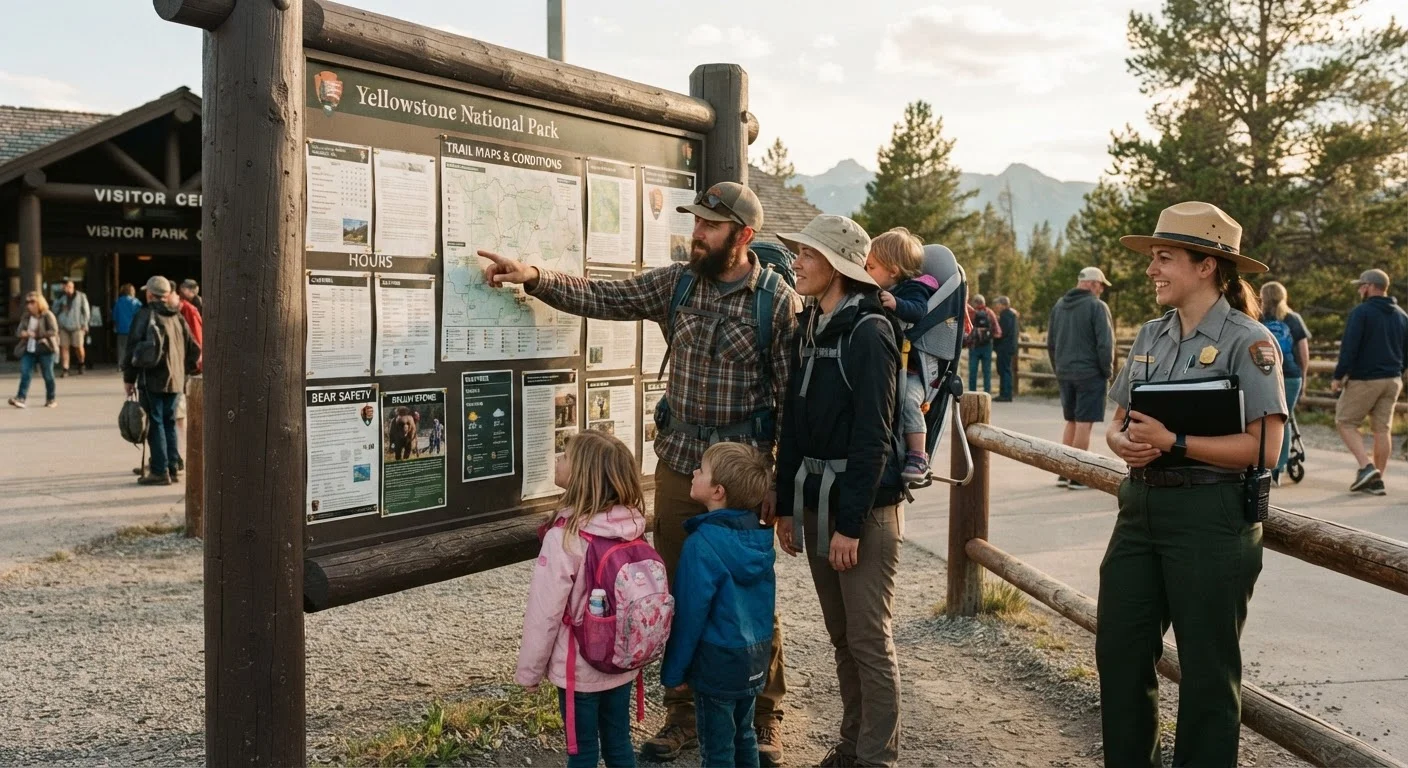
Visitor centers at national parks are free to enter and consistently underused by families who drive past them to reach a trailhead. Most contain museum-quality exhibits on the park's geology, ecology, or history, a free orientation film (usually 15 to 25 minutes), and ranger staff who can help you build a realistic itinerary based on your kids' ages and the day's conditions.
In hot or rainy weather, a visitor center also provides a no-cost, climate-controlled break that can reset a difficult day. Parks including the Smithsonian-affiliated sites within the National Mall in Washington, D.C. take this further, with full museum experiences at zero cost beyond getting there.
Visitor center films and exhibits are museum-quality experiences that cost nothing.
Stargazing and night sky programs
Several national parks hold formal International Dark Sky designations, including Capitol Reef, Big Bend, and Death Valley. These parks run free or low-cost ranger-led stargazing events, particularly in late summer and fall. Some provide loaner telescopes. Even parks without a formal designation often hold occasional evening programs during peak season.
Night sky programs work well for older kids and teenagers who may be less engaged by daytime nature walks. Check each park's event calendar on the NPS site before your visit. Arriving during a new moon phase improves visibility significantly, something worth noting when choosing travel dates.
International Dark Sky parks run free ranger-led stargazing events that hold up for all ages.
Getting more from every park visit
The activities above work best when you plan around them rather than discovering them after you have already filled the day. Before any park visit, check the park's official NPS page for its current program schedule, download the free NPS app, and confirm whether a fee-free day falls during your travel window. Entrance fees are also one of the costs families consistently underestimate when budgeting a trip; the hidden vacation costs guide covers how to account for them up front.
Beyond the budget angle, national parks deliver real physical and outdoor benefits that are hard to replicate elsewhere. Time on trails, in tidepools, and under open skies connects directly to the kind of low-cost active habits covered in physical activity without a gym membership. The value goes well past the dollar amount.
Download the NPS app before you arrive
The free National Park Service app lists current ranger programs, trail conditions, and maps for every park, and it works offline after you download a park's content at home. Checking the program schedule the night before your visit lets you build the day around free activities rather than figuring it out at the gate. It also shows real-time alerts for closures or weather-related changes.