

Key Takeaways
Why you do not need a gym to stay active
Gym memberships average over $500 per year per person, and for a family of four that cost adds up quickly. The good news is that the physical activity guidelines from the U.S. Department of Health and Human Services do not specify where movement happens, only that it happens. Adults need about 150 minutes of moderate aerobic activity per week, and children need about 60 minutes each day. Every one of those minutes can happen outside a gym.
Families who build movement into daily life rather than treating it as a separate scheduled event tend to stay consistent longer. A morning walk before school, an active chore routine, or a weekend hike all count. This article covers practical, no-cost and low-cost approaches that fit real family schedules. For a broader look at building sustainable health habits, see Building a Family Wellness Routine from Scratch.
Activity guidelines are a floor, not a ceiling
The weekly activity recommendations from federal health guidelines describe a minimum, not an ideal. More movement generally produces additional health benefits up to a point, and any amount is better than none. Families starting from a sedentary baseline should increase activity gradually to reduce injury risk. A healthcare provider can help identify an appropriate starting point for any family member with existing health conditions.
Low-cost ways to keep your family moving
Use public parks and trails as your gym
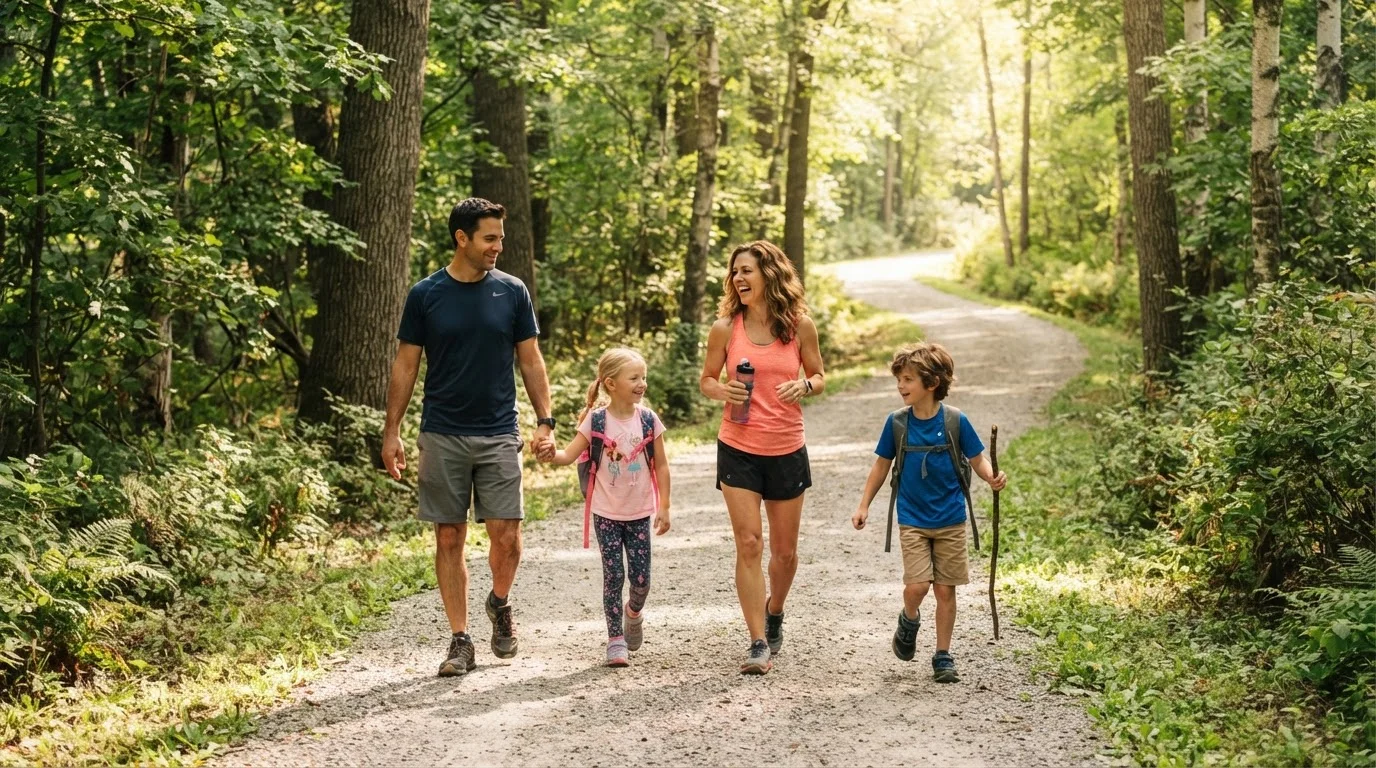
Most communities have free public green space within a short drive or walk. Parks provide open grass for sprints and sports, paved paths for walking or running, and playground equipment that doubles as fitness gear for both kids and adults. Many state and local trail systems are well-maintained and free to use year-round.
If your family enjoys traveling to natural spaces, national parks offer an especially broad range of free options. Free and Low-Cost National Park Activities Families Often Miss covers ranger-led hikes and free entry programs that make those visits accessible on a tight budget.
Most communities have free green space within a short distance that works as well as any gym floor.
Build bodyweight exercise into everyday routines
Push-ups, squats, lunges, and planks require no equipment and no space beyond a living room floor. Families can follow free workout videos through public library streaming services or YouTube, or simply cycle through a short circuit before dinner. Even 15 to 20 minutes of consistent bodyweight work several times a week provides measurable cardiovascular and strength benefits over time.
Involving children makes this more sustainable. When kids see parents doing floor exercises regularly, they tend to join in naturally rather than needing to be prompted.
A consistent 20-minute bodyweight routine at home produces real fitness gains without any equipment.
Walk with purpose and distance in mind
Walking is among the most well-researched forms of physical activity and requires nothing beyond comfortable footwear. A brisk 30-minute walk meets a meaningful portion of the weekly adult activity target. For families, walking becomes more engaging when paired with a destination: a local library, a farmers market, or a neighborhood park.
School-age children who walk to school accumulate meaningful daily movement before the school day even begins. Where distance or safety allows, this habit alone can satisfy a large share of the recommended 60 daily minutes for kids.
A brisk 30-minute family walk each day satisfies a significant share of weekly activity goals at zero cost.
Use community recreation centers and free programs
Many cities and counties operate recreation centers with reduced-fee or income-based access. Drop-in programs, free summer activity series, and youth sports leagues often run through parks and recreation departments at little or no cost. Local libraries sometimes host free yoga or fitness classes as community wellness programming.
Checking your city or county parks department website takes about five minutes and can surface free or low-fee options most families do not know about. These programs also give children structured social activity alongside physical movement.
City recreation programs frequently offer free or reduced-cost fitness classes that families overlook.
Make active play the default for family downtime
Unstructured active play, including pick-up sports, bike rides, jump rope, and backyard games, counts fully toward physical activity goals. The Centers for Disease Control and Prevention note that children benefit from a mix of aerobic activity, muscle-strengthening, and bone-strengthening movement, all of which happen naturally through unstructured play.
Replacing a single screen-heavy evening each week with an outdoor activity builds a habit over time. Families who document it, even just by tracking on a paper calendar, tend to maintain the pattern longer than those who rely on motivation alone.
Unstructured outdoor play counts fully toward activity goals and costs nothing beyond time and a little planning.
Treat household chores as movement opportunities
Vigorous housework, including vacuuming, scrubbing, mowing, raking, and carrying laundry, raises heart rate and engages multiple muscle groups. Assigning physically active chores to older children and teenagers contributes to their daily activity total while also teaching responsibility.
Gardening is another option worth considering. Digging, weeding, and hauling soil are all moderate-intensity activities. Community garden plots are often available through local programs at low or no cost, combining outdoor movement with a practical purpose.
Vigorous housework and yard work qualify as moderate-intensity physical activity according to standard guidelines.
Making it stick without spending more
The strategies above work best when they replace habits that already occupy time in your week rather than compete with them. Walking to a nearby errand instead of driving, doing bodyweight exercises during TV time, or turning a Saturday into a hiking day costs nothing extra and fits naturally into a schedule families already have.
Regular physical activity also supports other areas of family health. Pairing movement with routine preventive care strengthens that foundation. Many checkups and screenings that monitor the effects of an active lifestyle are available at little or no cost. See Preventive Care Your Family Can Get for Free (or Nearly Free) for what your family may already be entitled to under most insurance plans.
If keeping track of health spending is a concern, Monthly Financial Habits That Keep a Family Budget on Track offers a practical framework for fitting wellness costs into your monthly budget.
This article is for general informational purposes only and is not medical advice. Consult a qualified healthcare professional before starting a new physical activity program, especially for children, older adults, or anyone with a chronic health condition.