

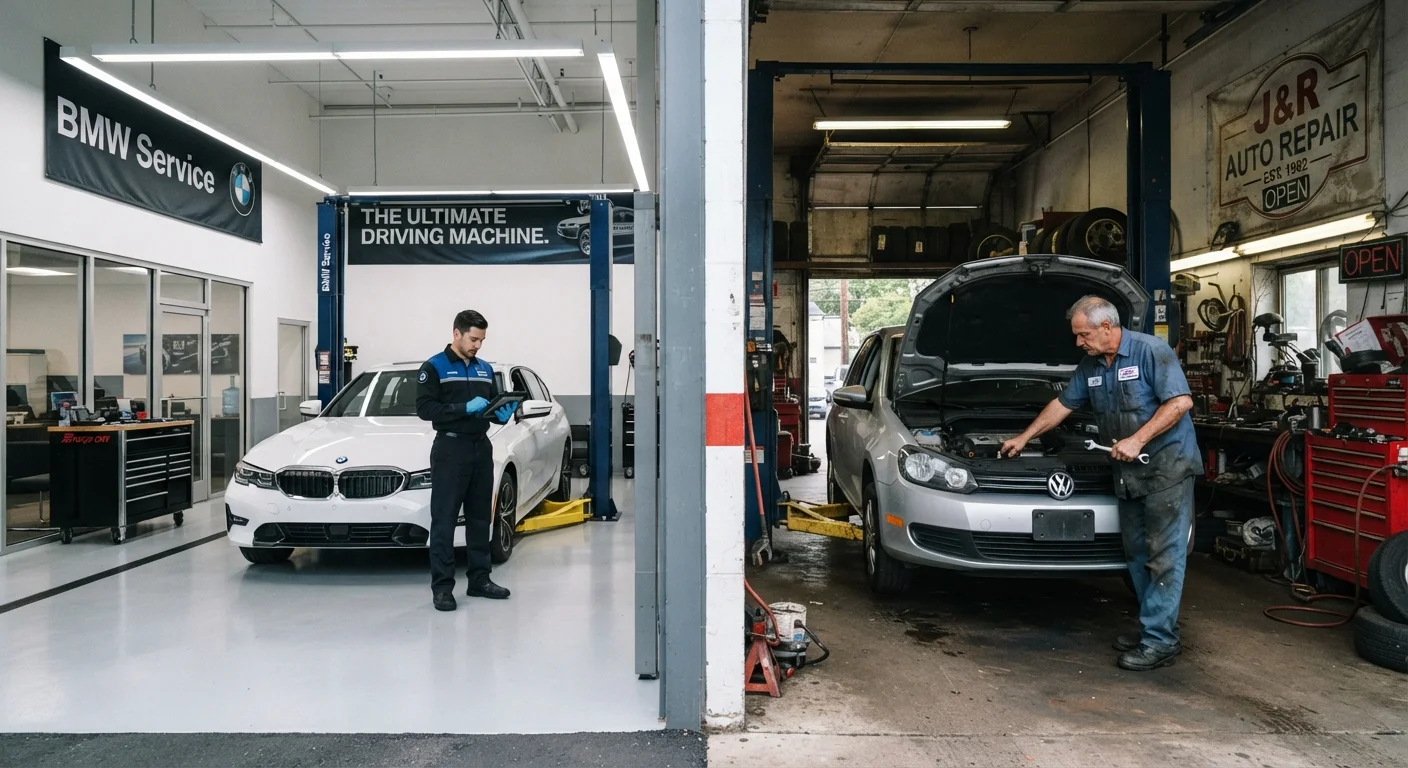
Key Takeaways
Option A
Dealer Service Center
The factory-trained, brand-specific option.
Best for: Owners with vehicles under warranty, recalls, or needing brand-specific diagnostic tools.
Option B
Independent Mechanic
The flexible, often lower-cost alternative.
Best for: Owners of older or out-of-warranty vehicles looking to reduce routine maintenance costs.
If your vehicle is still under the factory warranty
Dealer Service Center
Dealers handle warranty-covered repairs at no cost to you, and their technicians have direct access to manufacturer technical service bulletins and proprietary diagnostic software.
If you drive an older, out-of-warranty vehicle
Independent Mechanic
Labor rates at independent shops are typically lower, and a trusted mechanic who knows your vehicle's history can catch issues early without the overhead costs built into dealer pricing.
If your vehicle needs a recall repair
Dealer Service Center
Recall repairs are performed free of charge only at authorized dealerships, and only they can update manufacturer software and clear recall flags in the national database.
If you want routine oil changes and inspections at lower cost
Independent Mechanic
Routine maintenance at an independent shop usually costs meaningfully less per visit, and federal law protects your warranty rights when you use non-dealer service for maintenance.
If you own a European import or low-volume specialty vehicle
Dealer Service Center
Specialty vehicles often require brand-specific tools and software that most general independent shops do not stock, making dealer access worth the extra cost for complex repairs.
How pricing actually differs between the two
Dealer service centers set labor rates based on the manufacturer's suggested rate for their region, which tends to run between $130 and $180 per hour at many US franchises. Independent mechanics typically charge between $75 and $130 per hour, though rates vary by location and shop reputation. That gap adds up quickly on multi-hour jobs like timing belt replacements or suspension work.
Parts pricing is a separate matter. Dealers stock Original Equipment Manufacturer (OEM) parts, which are made to the same specification as what came on the car. Independent mechanics can source OEM parts through the same wholesale channels, but they also have the option to use aftermarket parts, which often cost less and vary in quality. When reviewing any estimate, check whether the shop is quoting OEM or aftermarket, and ask what warranty covers those parts. See our guide to reading a repair estimate for a breakdown of how to interpret labor hours and parts markups line by line.
| Criterion | Dealer Service Center | Independent Mechanic |
|---|---|---|
| Typical labor rate (US) | $130-$180 per hour | $75-$130 per hour |
| Parts sourcing | OEM parts standard | OEM or aftermarket options |
| Warranty repairs | Covered at no charge | Not eligible for warranty work |
| Recall repairs | Performed free of charge | Cannot perform recall work |
| Brand-specific diagnostics | Full proprietary access | Aftermarket tools; varies by shop |
| Technician training | Factory-trained for that brand | ASE certification varies by shop |
| Flexibility on repair approach | Limited to manufacturer procedures | More flexibility on parts and method |
| Ongoing vehicle familiarity | Tied to your service history at that dealer | Single shop can track full history |
What the Magnuson-Moss Warranty Act means for your service choices
Many vehicle owners assume that taking their car anywhere other than the dealer will void the factory warranty. That concern is understandable but largely incorrect. The Magnuson-Moss Warranty Act, a federal law, generally prohibits manufacturers from voiding a warranty solely because you used an independent shop for routine maintenance, as long as the work meets the manufacturer's specifications and proper documentation is kept.
Where this gets complicated is with modifications or the use of fluids and parts that do not meet manufacturer specifications. If an independent shop uses the wrong transmission fluid or skips a specification requirement, and a related failure occurs later, the manufacturer may have grounds to deny a warranty claim on that specific component. Keep your service records, use specification-compliant parts and fluids, and you are in a much stronger position. Our article on what your car's maintenance schedule is actually telling you explains which services are truly essential and what specifications matter most.
Specialized tools and diagnostic access
Modern vehicles rely heavily on proprietary software for diagnostics. A dealer technician can connect directly to the manufacturer's system to read fault codes, update firmware, and access technical service bulletins (TSBs) specific to your vehicle's VIN. Many independent shops use aftermarket scan tools that read generic OBD-II codes well, but may not access every manufacturer-specific data channel.
For complex electrical issues, transmission reprogramming, or advanced driver assistance system (ADAS) calibration after a collision repair, dealer access to proprietary tools is a genuine advantage. For a brake job, oil change, or water pump replacement, that advantage disappears. Matching the shop type to the job type is a practical way to manage costs without sacrificing quality.
ADAS calibration requires precision
If your vehicle has adaptive cruise control, lane-keeping assist, or automatic emergency braking, sensors and cameras often need recalibration after windshield replacement, front-end collision repair, or even some suspension work. Improper calibration can affect how these safety systems perform. Confirm that any shop performing this work has the calibration equipment specific to your vehicle's system, whether that is a dealer or a qualified independent specialist.
How to evaluate an independent shop before committing
Not every independent mechanic is equally skilled or trustworthy, and the same applies to dealer service departments. A few concrete steps can help you assess a shop before you hand over the keys.
- Check whether the shop employs ASE-certified (Automotive Service Excellence) technicians. Certification does not guarantee quality, but it confirms that the mechanic has passed standardized competency tests in specific repair categories.
- Ask whether they have experience with your vehicle make and model. Some independent shops specialize in Japanese or European imports; others focus on domestic trucks and SUVs.
- Request a written estimate before authorizing any work. A reputable shop will provide one without hesitation.
- Ask what parts brand they plan to use and whether those parts carry a warranty.
If a shop is reluctant to answer basic questions about parts sourcing or technician credentials, that hesitation tells you something. Common car maintenance myths can also lead you to authorize unnecessary services, so going in informed helps you push back on upsells regardless of which shop type you choose.