

Key Takeaways
Why repair estimates confuse people
A repair estimate is a legal document in most states, but it reads like an internal shop form. The shorthand, acronyms, and structure are designed for technicians, not vehicle owners. That gap creates confusion, and confusion often leads to approving charges without understanding what they cover.
The good news is that every line on a standard estimate falls into a small number of categories: labor, parts, fees, and tax. Once you know what each category means and how the numbers are calculated, the document becomes straightforward to read. The steps below walk through each section in the order it typically appears.
If you are deciding where to take your car in the first place, our guide to choosing between a dealer and an independent mechanic covers how cost structures differ between shop types.
Get the estimate in writing first
Most US states require shops to provide a written estimate before beginning work above a set dollar threshold, often $50 to $100. Never approve verbal-only estimates. If a shop calls with an additional repair need discovered mid-job, ask them to hold work, send a revised written estimate, and wait for your written or recorded authorization before proceeding.
How to read the estimate line by line
Work through the estimate using the steps below. It helps to have a pen and a calculator handy.
Confirm the estimate is itemized and written
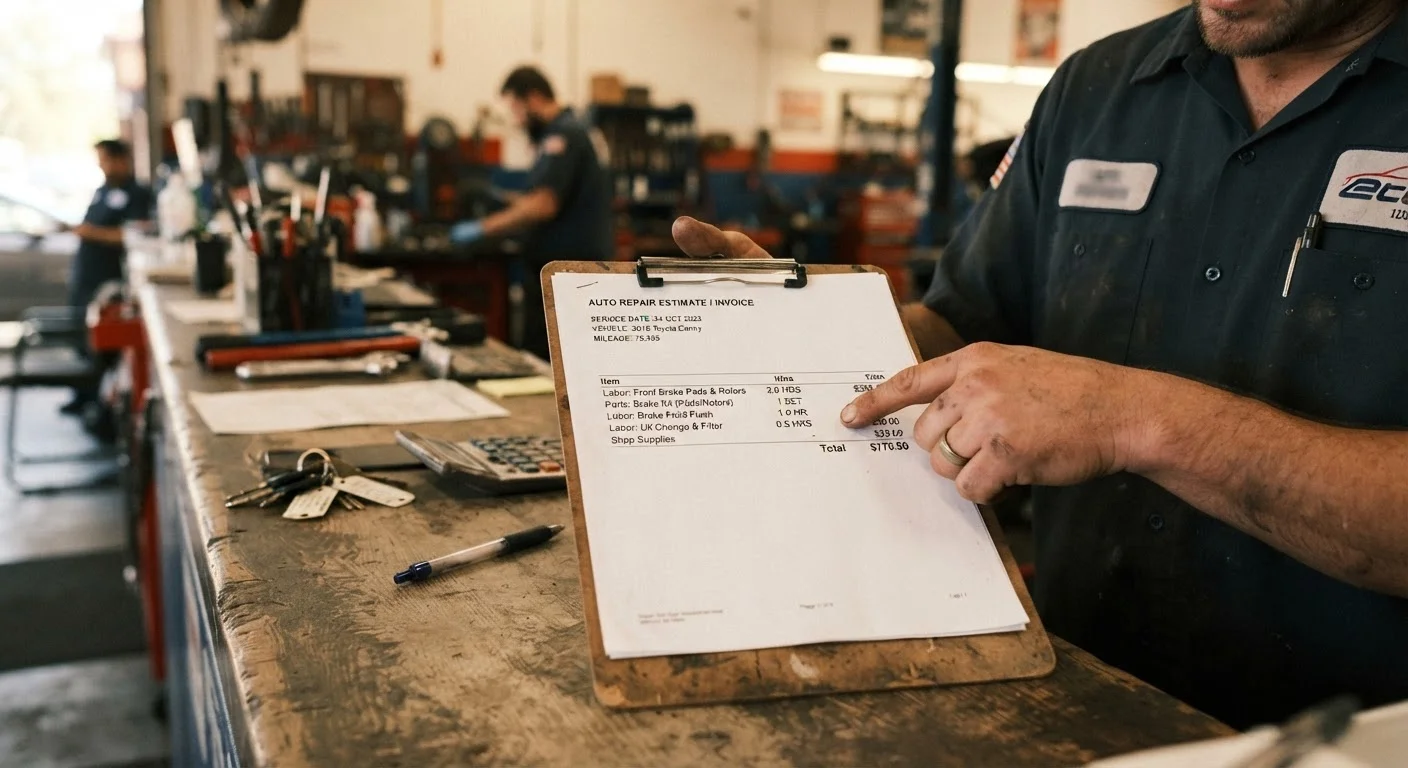
Before reviewing any numbers, check that the document separates labor, parts, fees, and taxes into distinct line items. A single lump-sum total tells you nothing. If the shop gave you only a total, ask the service writer to break it out. Reputable shops do this routinely, and state consumer protection laws in most jurisdictions require it.
Read the labor section
Each labor line shows a job description, a number of hours (sometimes shown as a decimal, such as 1.5), and a dollar amount. That hour figure almost never reflects actual clock time. Shops use flat-rate time guides, such as those published by Chilton or Mitchell, which assign a standard time to each repair. A technician who finishes faster still bills the flat-rate time; one who takes longer also bills that same time. The shop's hourly labor rate, typically printed at the top or bottom of the estimate, multiplied by the flat-rate hours equals the labor charge.
Check that the job descriptions match what you asked for. If you brought the car in for a brake noise and see 'engine diagnostic' as a labor line, ask why that work was included.
Review the parts lines
Each parts line should list a part name or number, a quantity, and a unit price. Shops buy parts at wholesale and sell them at a marked-up retail price. That markup, often 20 to 50 percent above wholesale, is how shops make margin on parts and is standard across the industry. You can ask the service writer whether the part is original equipment (OE), original equipment equivalent (OEE), or aftermarket. OE parts come from the vehicle manufacturer's supply chain. Aftermarket parts can be equal in quality or lower depending on the brand, and they typically cost less.
If a parts number is listed, you can look it up to verify it matches what was described. Confirm the quantity matches the job: a two-axle brake job should show four brake pads or two sets, not one.
Understand the diagnostic fee
A diagnostic fee covers the technician's time to connect scan tools, test components, and identify the problem. It is not a markup or a trick. Most shops charge between $80 and $175 for a diagnostic, depending on complexity and location. Many shops credit the diagnostic fee toward the repair total if you approve the work at that shop. Ask upfront whether the shop does this, because the answer affects your cost calculation if you decide to take the car elsewhere.
Check for shop supply and hazardous waste fees
Many estimates include a 'shop supplies' line covering items like rags, cleaning solvent, and fasteners used during the job. A 'hazardous waste disposal' fee covers proper disposal of old oil, coolant, or brake fluid. Both are legitimate costs. However, shop supply fees that appear as an open-ended percentage of the labor total, with no stated cap, are worth questioning. A flat fee in the range of $5 to $25 per job is typical for routine work; a percentage fee on a large repair can balloon unexpectedly.
Look at taxes and the final total
Sales tax typically applies to parts in most US states, while labor is often not taxed, though rules vary by state. Verify that tax appears only on the lines where it legally applies. Add up the pre-tax subtotals yourself to confirm arithmetic. Errors on estimates are uncommon but not unheard of, and catching one before you sign is far easier than disputing an invoice afterward.
Compare estimates the right way
When getting a second estimate, bring the first one with you and ask the second shop to price the same parts and labor tasks line by line. A lower total is only meaningful if both estimates cover identical work with comparable part quality. Comparing a dealer's OE-parts estimate to an independent shop's aftermarket-parts estimate requires accounting for that difference.
What to do after reviewing the estimate
Once you have verified each section, you have a few options. You can approve the work as written, ask for adjustments (such as substituting an aftermarket part for an OE part to reduce cost), request that non-essential repairs be deferred, or decline and get a second opinion.
If you ask the shop to change anything, request a revised written estimate before work begins. A verbal adjustment is hard to enforce at pickup. Most service writers will update the document without any friction; it protects them as much as it protects you.
Vague line items are a red flag
If an estimate lists only 'miscellaneous supplies' or 'shop supplies' without a dollar cap or explanation, ask the service writer to clarify what those charges cover before signing. Some shops apply a shop supply fee as a percentage of the total bill, which can add $20 to $50 or more to a routine job. You are entitled to know what you are paying for.
When a repair total feels high, the most productive step is asking the service writer to walk through the labor and parts charges verbally. In many cases a specific line item will have a straightforward explanation. In others, a polite question leads to a price adjustment, particularly on shop supply fees or on parts where the shop has flexibility on sourcing.