

Key Takeaways
Our Verdict
No single flooring type wins across every situation. Vinyl plank suits wet or high-traffic areas with minimal installation stress. Laminate works well in dry, lower-traffic rooms where cost is the main concern. Engineered hardwood fits families willing to spend more for a look and feel closer to solid hardwood, especially in living areas.
| Best for | Recommended |
|---|---|
| Wet areas or homes with pets and young children | Vinyl plank |
| Dry rooms on a tight budget | Laminate |
| Living rooms where hardwood appearance matters | Engineered hardwood |
| Households planning to refinish floors down the road | Engineered hardwood |
What each flooring type actually is
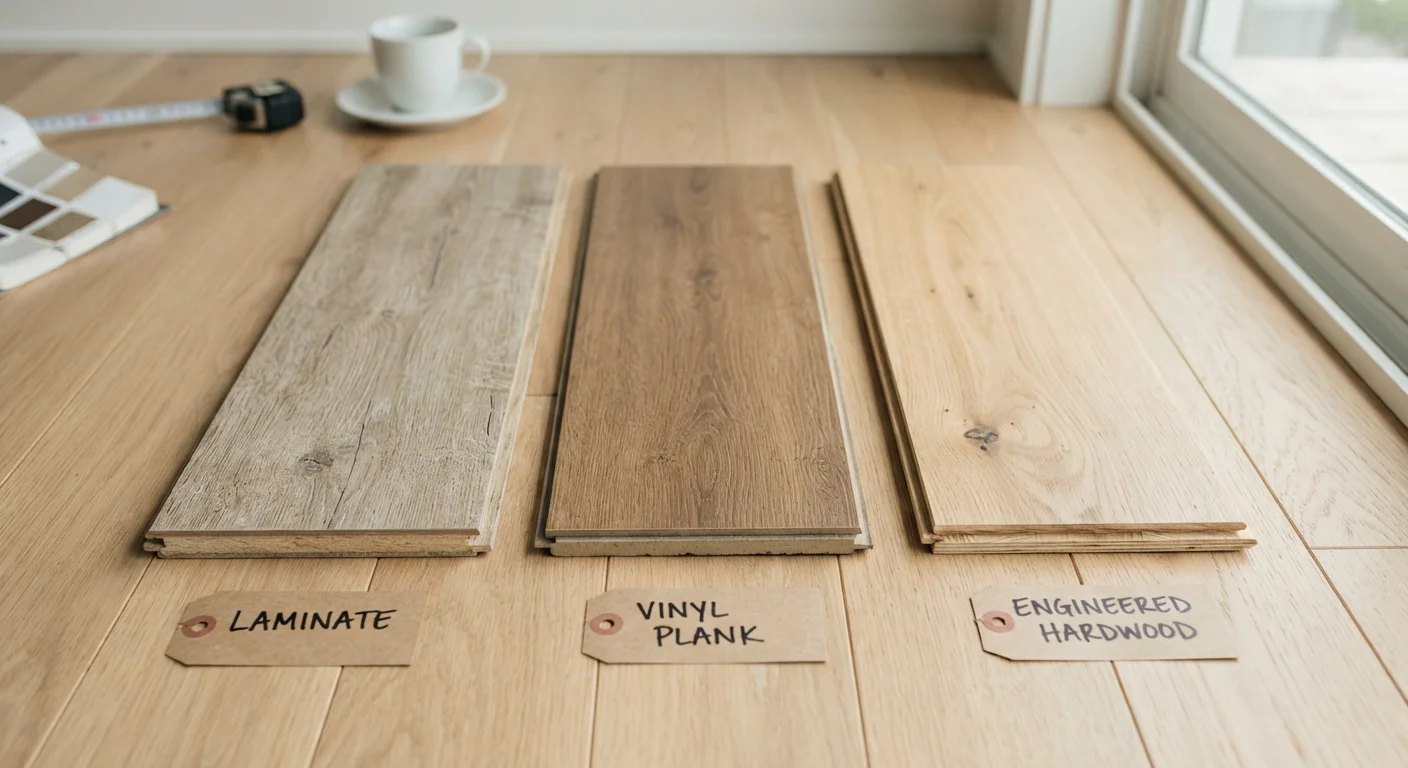
These three products look similar in showrooms but are built differently, and that affects how they perform over time.
Laminate is a composite product with a dense fiberboard (HDF) core topped by a photographic layer under a clear wear layer. The wood grain is a printed image. Because the core absorbs water, laminate swells and buckles when exposed to sustained moisture.
Vinyl plank (also called LVP or luxury vinyl plank) is made from PVC layers. It is 100% waterproof throughout, not just at the surface. Thicker products with an attached underlayment also deaden sound and feel softer underfoot.
Engineered hardwood has a real wood veneer on top, typically 1/12 to 1/6 inch thick, bonded to layers of plywood or HDF below. It looks and feels like solid hardwood because the surface layer is actual wood. The layered core resists cupping and warping better than solid planks, though it is still not fully waterproof.
Cost comparison across purchase and installation
Material prices fluctuate by region and product grade, so treat these figures as general ranges rather than quotes.
| Laminate | Vinyl plank | Engineered hardwood | |
|---|---|---|---|
| Typical material cost per sq ft | $1 - $4 | $2 - $5 | $3 - $8 |
| Waterproof | No | Yes | No (water-resistant) |
| Can be refinished | No | No | Yes, 1-2 times |
| DIY difficulty | Low | Low | Low to moderate |
| Typical lifespan | 10-25 years | 15-25 years | 25-30+ years |
| Best room types | Dry, low-traffic rooms | Any room, including wet areas | Living areas, bedrooms |
DIY installation can reduce labor costs significantly for all three. If you are planning other projects around the same time, see our guide on renting vs. buying tools for home projects to decide whether purchasing a flooring nailer or miter saw makes sense for your situation.
Durability, moisture, and everyday wear
Laminate wear layers are rated by an AC (abrasion class) number from AC1 to AC5. AC3 or AC4 is typical for residential use. Scratches are common in high-traffic areas, and since the surface is printed, scratches cannot be sanded out. Water left standing will ruin laminate planks within hours.
Vinyl plank is fully waterproof and generally more scratch-resistant than laminate at the same price point. It is softer underfoot, which matters in kitchens where people stand for long periods. However, heavy furniture can indent thinner vinyl plank products over time, and the color layer can fade in rooms with direct sunlight unless UV-treated.
Engineered hardwood can be lightly refinished one or two times depending on veneer thickness, which means surface scratches are not permanent. It tolerates humidity changes better than solid hardwood but should not be installed in rooms prone to standing water or high humidity without a vapor barrier.
Check underlayment before you buy
Many vinyl plank and laminate products now include attached underlayment, which saves a separate purchase and installation step. If your product does not include it, add a 2mm to 3mm underlayment for sound reduction and minor subfloor leveling. Engineered hardwood floated over concrete typically needs a vapor barrier underlayment to limit moisture transfer from the slab.
Installation: what DIY actually looks like
All three products commonly use a floating click-lock system, meaning planks snap together without glue or nails and rest on top of the subfloor. This makes them accessible for first-time DIYers with basic tools.
Laminate generally has the most forgiving click systems and is the most widely documented for DIY. The main requirement is a flat, clean subfloor. High spots or dips greater than 3/16 inch over 10 feet will cause planks to rock and the locking joints to fail.
Vinyl plank is flexible enough to conform to minor subfloor irregularities, which is an advantage in older homes. It cuts easily with a utility knife and straightedge. Thicker planks (6mm and above) are more stable and easier to install than thin budget options.
Engineered hardwood can be floated, glued, or stapled/nailed down depending on the product and subfloor type. Floating installation is the simplest for DIYers, but glue-down and nail-down methods require more tools and experience. Permits are not typically required for flooring replacement, but always verify local building codes if you are also modifying subfloor structure.
Long-term value and when to spend more
Laminate has a typical lifespan of 10 to 25 years depending on traffic and moisture exposure. When it fails, full replacement is usually required because individual planks cannot be repaired once swollen. It is a reasonable choice in a guest bedroom or a rental where cost control matters more than longevity.
Vinyl plank can last 15 to 25 years with normal care. Because it is waterproof throughout, it holds up in conditions that destroy laminate. If you are finishing a basement, installing in a mudroom, or have a household with dogs, vinyl plank generally makes more financial sense over time despite a similar or slightly higher upfront cost than laminate.
Engineered hardwood carries the highest upfront cost but can last 25 to 30 years or more with care. The ability to refinish extends its useful life and maintains appearance after years of heavy use. For families who plan to sell their home, real-wood flooring (even engineered) often reads better to buyers than vinyl or laminate, though this is not a guarantee of resale value.
For families weighing budget decisions across multiple home and travel projects, the same cost-comparison logic applied to flooring applies elsewhere. See our breakdown of renting a vacation home vs. staying in a hotel for another example of how upfront cost and long-term value do not always point the same direction.