

Key Takeaways
Why insulation myths cost families real money
Insulation decisions are rarely reversible without significant cost. Filling a wall cavity with the wrong material, or skipping air sealing before insulating an attic, can mean spending money twice: once on the original installation and again on corrections. Families who rely on incomplete or inaccurate information about insulation often end up either over-buying unnecessary material or under-protecting their homes against heat loss.
The myths below are common enough that contractors and home energy auditors encounter them routinely. Getting these facts straight before starting a project can make the difference between a cost-effective upgrade and an expensive mistake. For a related look at how similar misconceptions affect other household budgets, the money myths that keep families from getting ahead article covers overlapping territory.
Myth
A higher R-value is always better, no matter where you put it.
Fact
R-value recommendations vary by location in the home and by climate zone. Exceeding the recommended level yields diminishing returns on energy savings.
R-value measures thermal resistance: the higher the number, the slower heat moves through a material. But the Department of Energy publishes zone-specific recommendations because the optimal R-value for a wall in Florida is genuinely different from one in Minnesota. Installing R-60 insulation in an attic in a mild climate adds cost without a proportional reduction in energy bills. The relationship between R-value and heat loss is not linear, so doubling the R-value does not cut heat loss in half.
Before purchasing insulation, check the DOE's climate zone map and its corresponding recommendations for attics, walls, and floors over unconditioned spaces. Matching material to location and climate is more cost-effective than simply buying the thickest product available.
Myth
You can just pile new insulation on top of old insulation without any preparation.
Fact
Old insulation that is wet, compressed, or contaminated must be addressed before adding new material; layering over a problem does not fix it.
Fiberglass batts that have absorbed moisture lose their R-value significantly. Adding a fresh layer on top traps the dampness, which can promote mold growth inside the wall or ceiling cavity. Compressed insulation, common in older attics that have been used for storage, also performs below its labeled R-value because the air pockets that provide resistance have been squeezed out.
Before any addition, inspect existing insulation for discoloration, odor, or signs of pest activity. Wet or contaminated material should be removed and the source of moisture identified. For a broader look at where weatherization efforts pay off, see our guide to home weatherization.
Myth
Insulation alone will keep your home comfortable and cut your energy bills.
Fact
Insulation slows heat transfer, but air leaks move heat much faster than conduction through walls. Air sealing must come first.
Heat moves through a home by three mechanisms: conduction (through solid materials), convection (through air movement), and radiation. Insulation addresses conduction, but gaps around recessed lights, plumbing penetrations, electrical outlets, and attic hatches allow conditioned air to escape rapidly by convection. A well-insulated wall with a drafty electrical outlet will still feel cold in winter.
The standard approach is to air seal first, then insulate. Foam sealant and caulk around penetrations are inexpensive and relatively straightforward for most homeowners to apply. Skipping this step is one reason some families invest in insulation upgrades and see smaller savings than expected.
Myth
Spray foam insulation is so effective that it works well anywhere in the home.
Fact
Spray foam has genuine advantages in specific applications, but it is not the right material for every situation and can cause problems when used incorrectly.
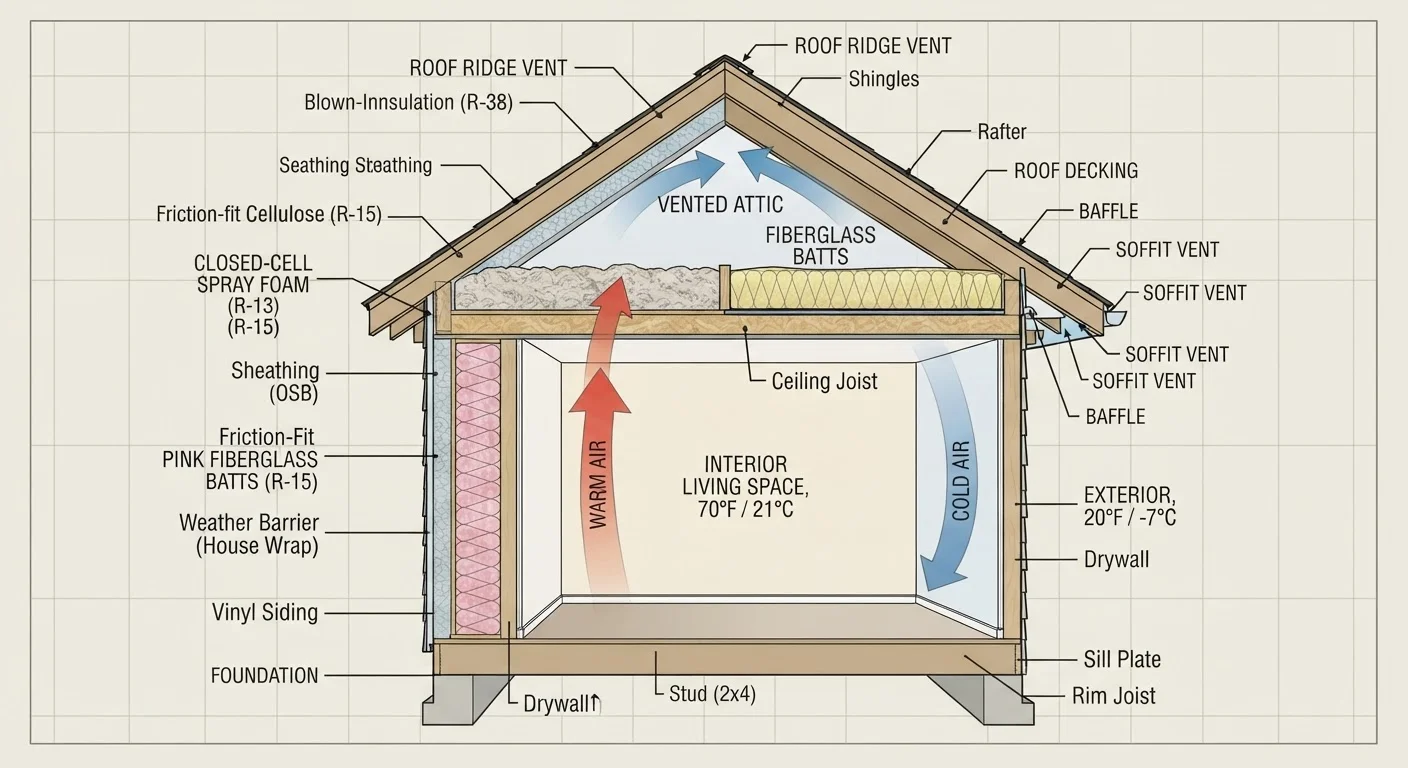
Closed-cell spray foam has a high R-value per inch and acts as an air and vapor barrier, which makes it useful in crawl spaces and rim joists. Open-cell spray foam is vapor-permeable, which means it can allow moisture to pass through and is not appropriate as a vapor retarder in cold climates without an additional barrier.
Spray foam applied directly to the underside of roof sheathing creates an unvented attic assembly. This can work well when done correctly, but it changes how the roof system manages moisture and requires the work to meet local building codes. Improper application can trap moisture and accelerate sheathing decay. Two-component spray foam kits sold for DIY use are suitable for small gaps and rim joists, but full-cavity application is typically a job for a licensed contractor.
Myth
All insulation types perform the same way, so cost is the only difference.
Fact
Each insulation material has distinct performance characteristics that affect suitability by location, climate, and application.
Fiberglass batts are inexpensive and widely available, but they must fit the cavity exactly to perform as rated. Gaps and compression reduce their effectiveness. Loose-fill cellulose settles over time, which is why installers add extra depth to account for settling. Rigid foam boards provide a continuous thermal break on exterior walls, which batts inside stud cavities cannot provide because heat still conducts through the wood framing (this is called thermal bridging).
Material choice affects long-term performance, not just upfront cost. For more perspective on how DIY decisions can have unintended financial consequences, see why DIY home repairs often cost more than expected.
Myth
Once insulation is installed, it never needs to be checked or replaced.
Fact
Insulation can degrade, settle, or become contaminated over time, reducing its performance below what the original installation achieved.
Loose-fill insulation in attics settles gradually and may need to be topped up after several years to maintain the desired R-value. Fiberglass batts can be displaced by animal activity or compressed during attic storage use. Cellulose insulation, which is made from recycled paper, can absorb moisture if a roof leak or condensation problem develops, significantly reducing its thermal resistance.
A periodic visual inspection of accessible insulation, such as in the attic, helps catch these issues before they become costly. Signs to look for include visible gaps, discoloration, or evidence of pests. Checking insulation every five to ten years is a reasonable interval for most homes.
What to check before adding or replacing insulation
Before purchasing any insulation material, confirm three things: the existing condition of any insulation already in place, the air sealing status of the area you plan to insulate, and the DOE climate zone recommendation for your location. All three are available without spending money. The DOE's Energy Saver website publishes R-value recommendations by zone, and a basic attic inspection costs nothing beyond a flashlight and a few minutes of time.
If you suspect moisture intrusion, address that before any insulation work. Installing new insulation over a slow roof leak simply hides the damage and worsens it. Local building departments can tell you whether permits are required for insulation work in your area, since requirements vary by jurisdiction and scope of work. Permits exist to protect homeowners, and skipping them can create complications during a future home sale.
Up to 30%
Energy lost through air leaks in typical homes
The U.S. Department of Energy estimates that air leaks account for up to 30% of heating and cooling energy loss in a typical American home.
8 zones
DOE climate zones governing R-value recommendations
The Department of Energy uses eight climate zones across the U.S., each with different recommended R-values for attics, walls, and floors.
15-25%
R-value loss from compressed fiberglass batts
According to building science research, fiberglass batts that are compressed to fit an undersized cavity can lose 15-25% of their rated thermal performance.